

Can an AI agent transfer purchase orders and delivery notes from PDF into the ERP system?
Purchase orders arrive by email as PDFs, delivery notes come with the goods or as PDFs too. Someone types both into the ERP system. An AI agent can take this over. How it works step by step, what it needs and why this fits manufacturing businesses in Carinthia in particular.
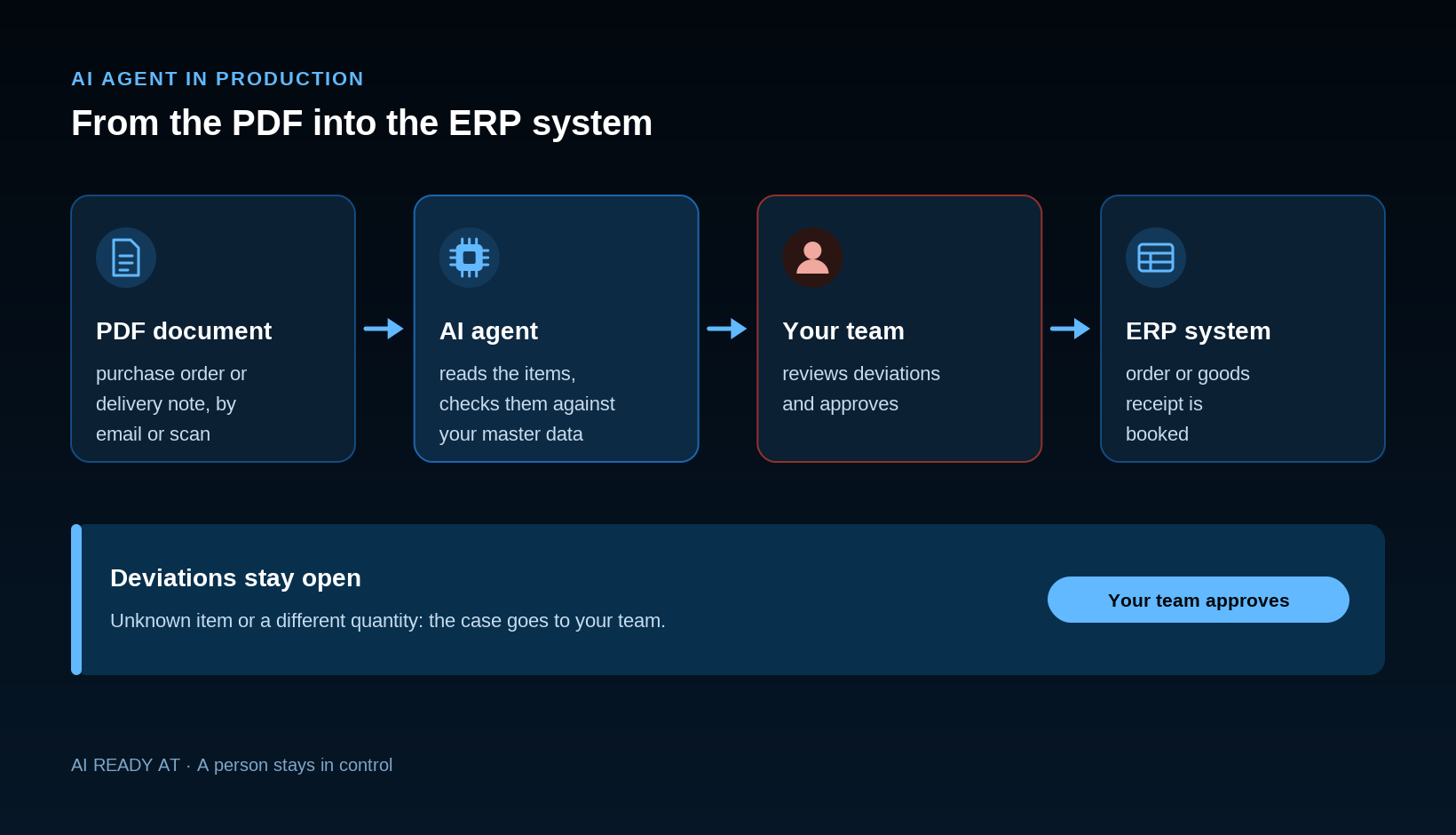
The short answer: yes. An AI agent is a program that carries out a recurring task step by step on its own and asks a person when something is unclear. It reads purchase orders and delivery notes from PDF files, recognises the customer or supplier, items, quantities and dates and enters the data into the ERP system. The ERP system is the program for orders, stock, purchasing and accounting. Anything that does not match, such as an unknown item number or a different quantity, is not booked. The agent passes the case to your office team with a reason.
Why does typing it in take so much time?
Because every purchase order looks different. One customer sends a PDF from their purchasing program, another a scanned page, a third writes the items into the email text. For the office team that means: open the PDF, find the customer, translate the customer's item number into your own, type in quantity, price and delivery date, read it back. At goods receipt it happens again with the delivery note: does the quantity match the order? Is anything missing?
Each document is quick. Added up, it is work that comes back every day. And typing errors become expensive, because they often only show up in the warehouse or on the invoice.
How an AI agent transfers purchase orders and delivery notes, step by step
- The agent collects the documents. From the inbox for purchase orders or from the folder where goods receipt scans delivery notes. It only gets access to what it needs.
- It reads the PDF. Customer or supplier, order number and every line with item, quantity, unit, price and delivery date. This also works with scanned pages and when every customer uses their own form.
- It checks against your master data. Does the customer already exist? Which of your item numbers belongs to the customer's number? Does the price match the price list and the delivered quantity match the order?
- It prepares the booking. The order or the goods receipt is filled in and ready.
- Your team approves. If everything fits, a quick look is enough. Deviations are marked, with a reason and the place in the PDF.
What changes: the office team no longer types, it reviews. Orders are in the system faster. Deviations show up on arrival and not only on the invoice.
Does this work with our ERP system?
In most cases, yes. Whether your business works with SAP, Microsoft Dynamics 365 Business Central, BMD or an industry-specific program makes little difference to the process. What matters is how the data gets into the program. There are three ways:
- Through an interface. That is the connection two programs use to exchange data. If your program has one, this is the cleanest way.
- Through an import file. Many programs can read orders from a table. The agent creates this file.
- Through the screen. If neither exists, the agent operates the program like an employee, with mouse and keyboard. The article Software without an interface explains this in more detail.
Which way fits your business is something we clarify at the start, together with your IT team or the company that looks after your program.
Why does this fit manufacturing businesses in Carinthia in particular?
Because industry carries more weight in Carinthia than in Austria as a whole. The production sector contributes 36.3 per cent of value added in Carinthia, compared with 27.4 per cent across Austria. Manufacturing alone accounts for 20.0 per cent in Carinthia and 16.9 per cent across Austria. These are figures from Statistics Austria for 2024. Where a lot is produced, a lot of purchase orders and delivery notes pass through the offices.
On top of that, businesses already use AI. According to Statistics Austria, 32.5 per cent of manufacturers in Austria used artificial intelligence in 2025, compared with 29.9 per cent across all sectors. And Carinthia prefers automating to analysing: of the Carinthian businesses using AI, 21.4 per cent use it to automate processes and 18.0 per cent to analyse data. Across Austria it is the other way round.
What does a business need for this to work?
- Well-kept master data. Customers, items and prices have to be right in the system. The agent can only check against what is there.
- Rules for deviations. From what difference in quantity or price does the agent ask? Who receives the case?
- A fixed entry point. One inbox for purchase orders, one folder for scanned delivery notes.
- A trial run with real documents. At first the agent runs alongside your team. Only when the results are right does it prepare bookings.
- Protection for trade secrets. Prices, customer lists and drawings stay under your control. If you wish, the AI runs on a computer of your own on your premises.
What this means for your business
Start with one type of document, ideally the one that arrives most often. We look at how purchase orders and delivery notes reach you today, agree rules and exceptions with you and test with your real documents. Nothing is booked until your team approves. Our AI security gateway checks what is sent to external AI services.
Under AI in industry you will find more use cases for manufacturing businesses. Under AI consulting in Carinthia you can read how we support businesses in Villach, Klagenfurt and across Carinthia.