

Can an AI agent create offers straight from our hotel software?
The enquiry arrives by email, rooms and rates sit in the hotel software. In between, someone at reception copies from one to the other by hand. An AI agent can connect the two. This article shows how it gets to availability and rates, what it may not do without approval and why this fits hotels in Carinthia right now.
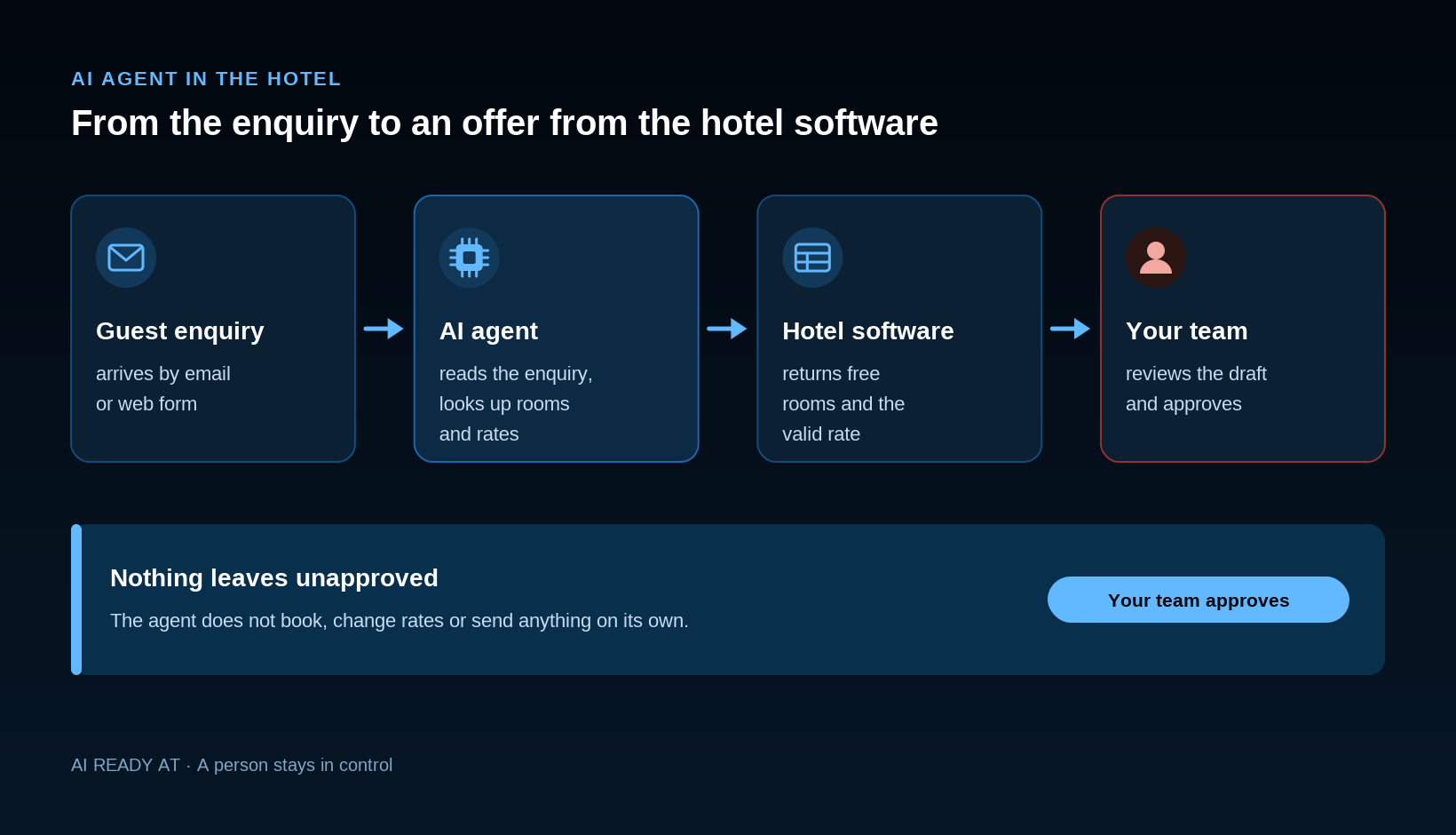
The short answer: yes, if the hotel software releases the data. The hotel software, often called PMS, is the program for rooms, rates, bookings and guest data. An AI agent is a program that handles a recurring task step by step on its own and asks a person when something is unclear. It reads the enquiry, looks up free rooms and the valid rate in the hotel software and drafts an offer from that. Nothing is sent until someone on your team approves.
Where does the time go today?
Rarely into writing. The time goes into looking things up. Is the double room with lake view free in the second week of August? Does the summer rate already apply? Is there a package for four nights? For every enquiry, reception switches between the inbox, the room plan and the rate list.
On a quiet Tuesday nobody notices. On a Saturday with arrivals, enquiries pile up, and guests who wait longer for an answer often ask another hotel as well.
How an offer is created from the hotel software, step by step
- The agent reads the enquiry. Travel dates, number of guests, children with their ages and wishes such as half board or a dog.
- It asks the hotel software. Which rooms are free in that period, which rate applies, which package fits.
- It checks your rules. Minimum stay, arrival days, reductions for children, cancellation terms.
- It writes the draft. In your tone, with your text modules and in the guest's language.
- Your team approves. A quick look, a change if needed, then the offer goes out. If you wish, the agent then enters the option in the room plan.
If something is missing from the enquiry, such as the children's ages, the agent does not put a guess into the offer. It prepares the question back to the guest.
Does this work with our hotel software?
Whether your hotel works with Protel, Casablanca, Gastrodat, Mews or another program changes little about the process. What matters is how the agent gets to rooms and rates. There are three ways:
- Through an interface. This is the connection two programs use to exchange data. Whether your program has one and what it releases is something we clarify with the vendor or with the company that looks after your program.
- Through an export file. The hotel software regularly writes the room plan and rates to a file, and the agent reads it. Availability is then as current as the last export. That is why your team checks it again when approving.
- Through the screen. If neither exists, the agent operates the program like an employee, with mouse and keyboard. The article Software without an interface explains more.
We tell you before the start which way works with your program. If none of them is clean, we do not build the agent.
What may the agent not do?
Without approval it books nothing, changes no rates and sends nothing. In the hotel software it only reads what it needs for the offer. Guest data stays in your programs. Our AI security gateway checks what is sent to external AI services.
Why does this fit hotels in Carinthia right now?
Because more guests are coming and staying for a shorter time. In 2025 Carinthia counted 3,273,563 arrivals, more than ever since records began, and 13,061,976 overnight stays. Arrivals rose by 0.3 percent, overnight stays fell by 0.9 percent. These are figures from the statistics office of the Province of Carinthia. The two numbers work out at a stay of around four nights.
This is how we read it: for the same occupancy, a hotel needs more bookings than before. More bookings means more enquiries and more offers, with the same number of people at reception.
What this means for your hotel
Start with one type of enquiry, for example the room enquiry for the summer. We look at how enquiries reach you today and which data your hotel software releases. Then the agent first runs alongside your reception, and you compare its drafts with your own offers. Our office is in Villach, and we are happy to come to your hotel for the start.
What the agent does day to day is described on the page AI agent for hotel enquiries. You will find more use cases under AI in tourism, and under AI consulting in Carinthia you can read how we support businesses in Villach, Klagenfurt and across Carinthia.