One thing needs to be stated plainly: the experts badly misjudged the pace. For a long time the consensus was that autonomous AI agents shaping everyday working life were still five to ten years away. Classical workflow automation and consultancy would suffice in the meantime. Reality has long since overtaken that assessment. Agents are no longer a vision of the future — they are here. Just often in a different form than anyone imagined two or three years ago.
Objective-Setting Instead of Step-by-Step Instructions
The truly fundamental difference from what was previously understood as AI lies less in technical performance than in the division of roles. With classical generative AI, the human is the operational controller: one input, one response, and you have to act again yourself for every next step. With agentic systems, that role shifts to the strategic level. You define the goal — the system takes over analysis, planning and the execution of the necessary steps. If a problem arises along the way, such as an error in the code, the agent adjusts its path independently rather than waiting for the next input.
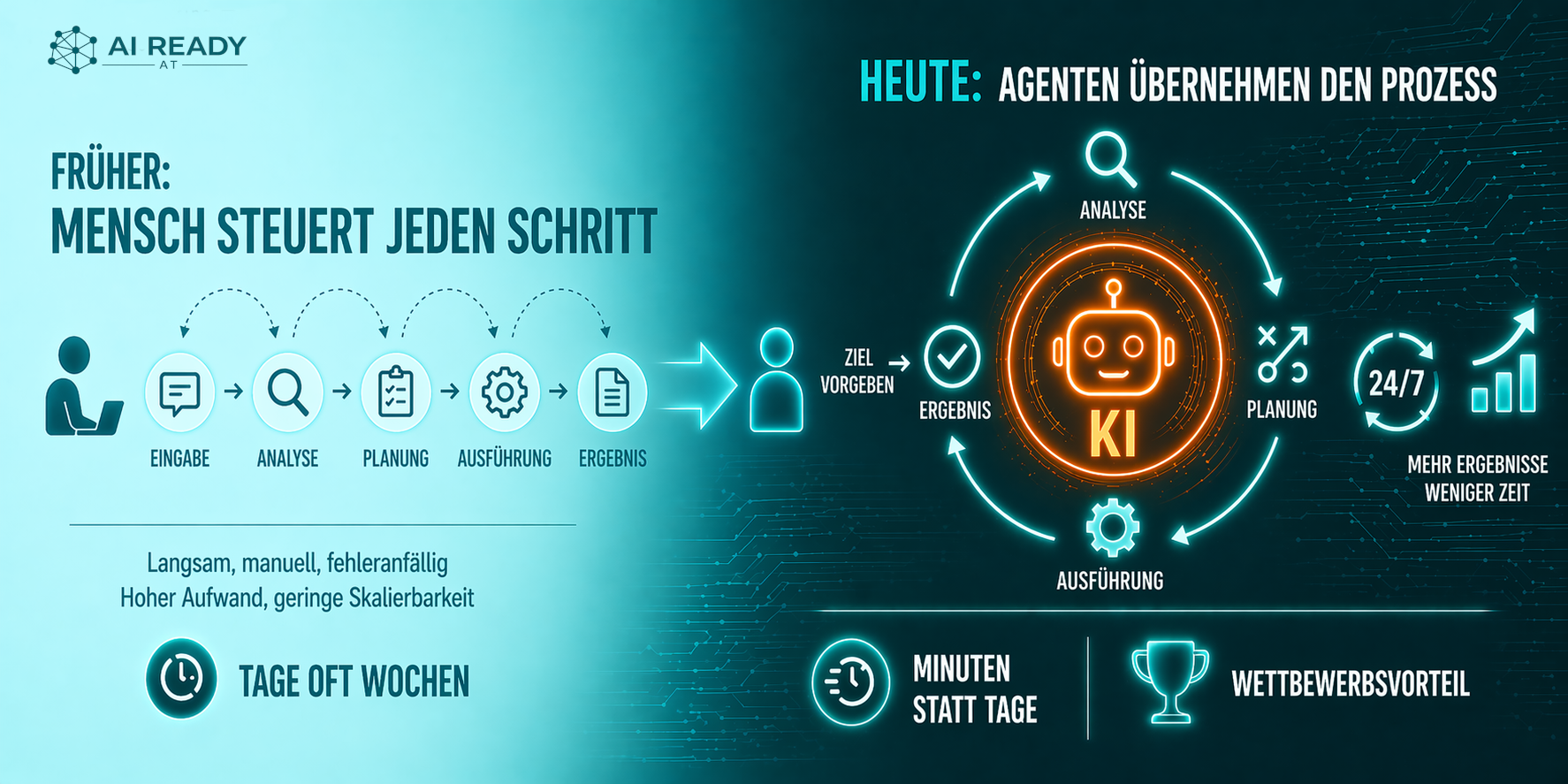
In the past, AI was good at clearly defined individual tasks. Today, modern systems work on complex projects over longer periods, and the efficiency gain is considerable. Deploy several agents in parallel on a single goal and the processing time drops dramatically. An example I encounter increasingly in mid-sized businesses: the creation of complex customer quotes including material and supplier queries. What previously required significant manual effort over several days can now be handled in a fraction of the time. This is not a theoretical possibility — it is lived practice.
Scalability Without Meaningful Limits
Since most computer-based processes can be broken down into code, there are hardly any fundamental limits to deploying such agents. The real barriers today lie less in the AI itself than in interfaces, integrations and access rights to the systems it needs to work with. Anyone who hasn't prepared that groundwork will notice quickly.
The major lever comes from sheer processing speed. Human specialists need weeks to work through technical literature, datasets and spreadsheets and draw meaningful connections. An agent handles this at a scale that can no longer be compared to a working day.
Of course, technical limits remain. The context window — a kind of short-term memory for the system — is finite, and the susceptibility to error has not disappeared. But the pure processing of large and complex volumes of data is no longer a fundamental obstacle.
What This Means for Businesses
The real management question shifts as a result. It is no longer: which tool do we buy? But: where in our processes does a digital employee give us the greatest leverage? Anyone who answers that question clearly and sets up the necessary interfaces builds a lead that a later purchase will not make up. The window in which genuine competitive advantages can be carved out is widest open right now.
A Look Ahead: From Individual Agent to Complete System
The most exciting step, in my view, is still ahead. Individual agents are useful, but their real impact unfolds when they work together — when one picks up where another leaves off, and when they coordinate with each other without anyone directing every move. This is exactly what is being worked on now: a kind of AI operating system that connects the individual digital employees into an orchestrated whole. Loose tools become a coherent architecture in which tasks, data and decisions interlock cleanly. More on that in a future article.