If I'm honest: the most compelling stories around artificial intelligence right now are not about the companies boldly leading the charge. They are about the ones at risk of falling behind — and who no longer quite know how to close the gap.
Public debate is heavily shaped by uncertainty, regulation and potential risks. Understandable, since AI is not just changing individual processes but entire industries. Yet a paradox emerges that I keep noticing: while risks are being debated, a strategically far greater risk is growing in parallel — missing a historic opportunity.
When Caution Becomes the Most Expensive Mistake
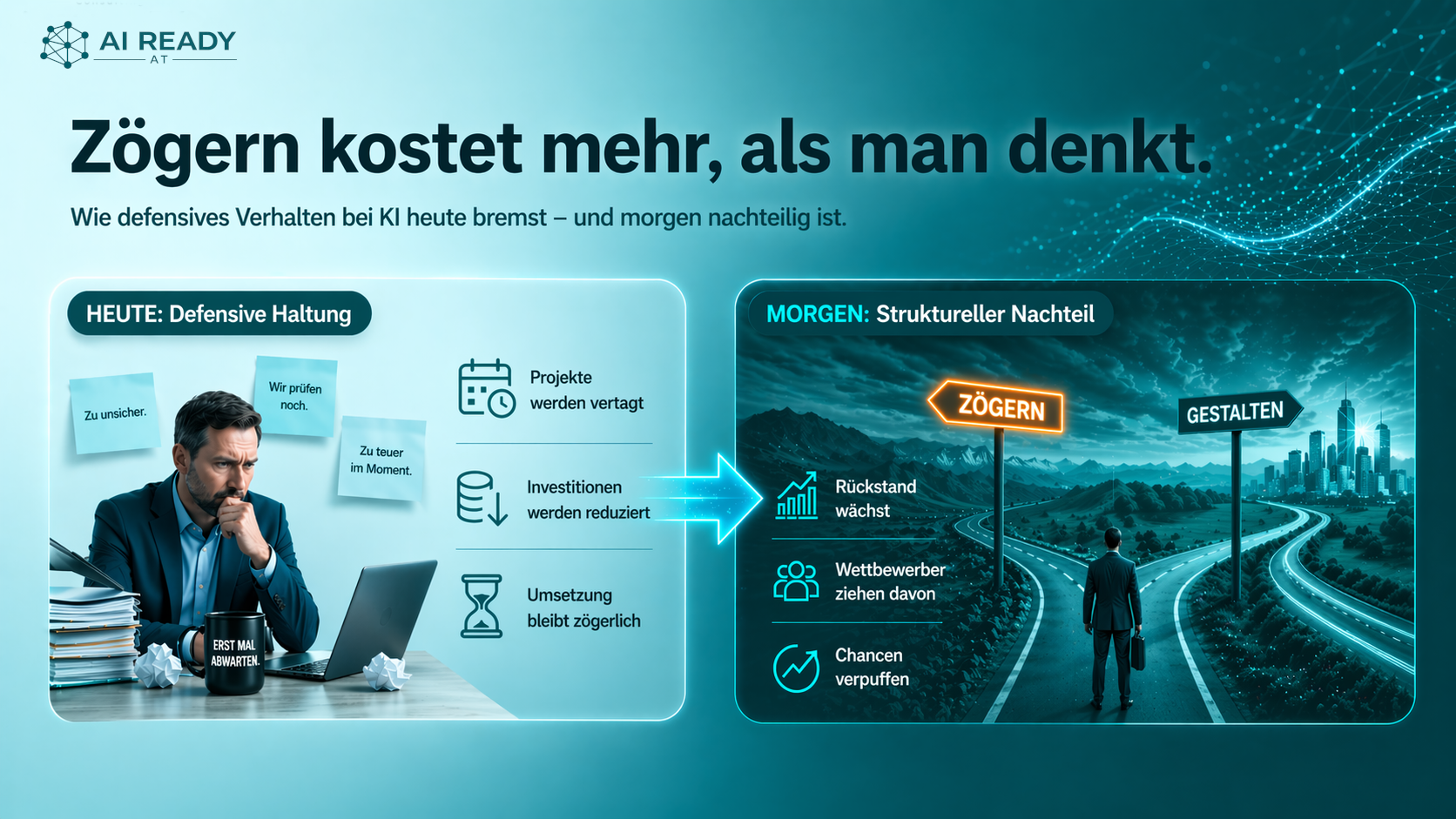
The real problem rarely lies in the technology itself, but in how it is handled. Hesitation quickly develops into the strongest brake. Those who view AI purely defensively tend to hold themselves back — projects get postponed, investments reduced, pilot phases extended until they eventually run into the sand.
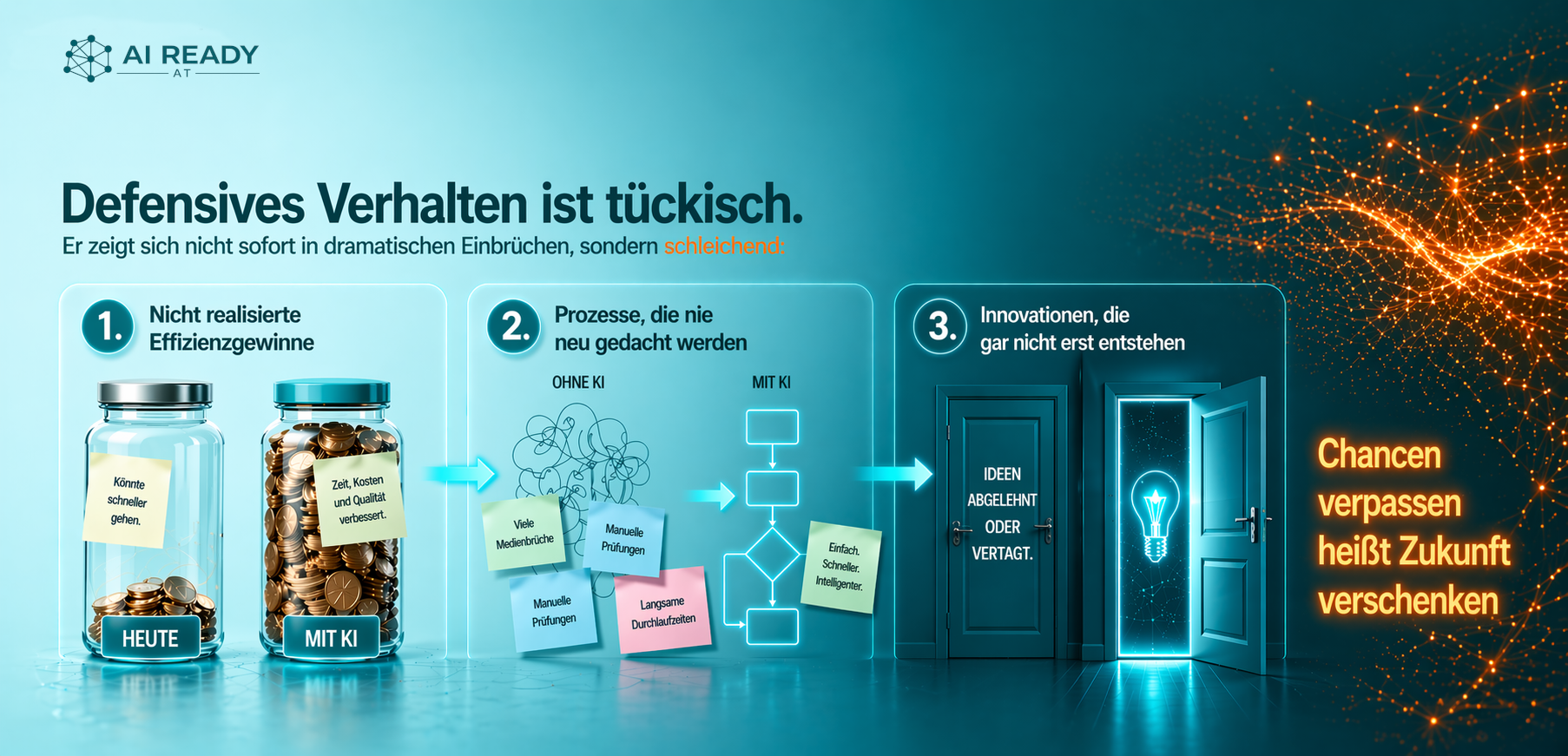
There is also a widespread misunderstanding at play. Companies that use AI only superficially — through individual chat queries, for instance — are usually only scratching the surface. The genuinely interesting potential lies deeper: where entire workflows are automated and the technology independently takes over tasks. What looks like prudence in the short term becomes a disadvantage in the long term. And that disadvantage rarely arrives with a bang. It creeps in: efficiency gains fail to materialise, processes never get truly rethought, innovations never get off the ground.
On the Other Side of the Market
At companies that are actively working with AI, I see a completely different picture. They are becoming faster, more productive, more adaptable. Decisions are more data-driven, structures more agile. At the beginning, not everything runs smoothly — systems need calibrating, processes sharpening, experience accumulating. But that very learning phase becomes the advantage. Once operations are stable, the lead has already been built.
The pressure in the market is real. Efficiency is rewarded, investors expect growth, competitors exploit every gap. The question is no longer "whether" but "how fast."
The Gap Is Growing — and Fast
What I find particularly interesting is the interplay between human and machine. The greatest levers emerge not from AI alone, but from its meaningful integration into day-to-day work. That is where new products, business models and forms of value creation take shape. Those who don't use this lever are not just foregoing optimisation — they are foregoing genuine transformation.
Capital markets are also paying closer attention. How a company handles AI is becoming a measure of future viability. And so a gap forms between those moving forward and those waiting — a gap that is widening rapidly.
The missed opportunity doesn't happen all at once. It forms step by step — exactly where hesitation takes hold.