The past three years were the era of AI assistants. AI was initially used mainly for text and image creation, while early AI automations began to emerge alongside. Measurable effects, however, appeared almost exclusively where processes were actually automated. At the same time, a boundary became visible quickly: the systems operated on general, external knowledge — not on the specific knowledge of the organisation itself. The result was superficial support, frequently hampered by hallucinations, rather than operating on the basis of real business data.
The Dead End of Horizontal Adoption
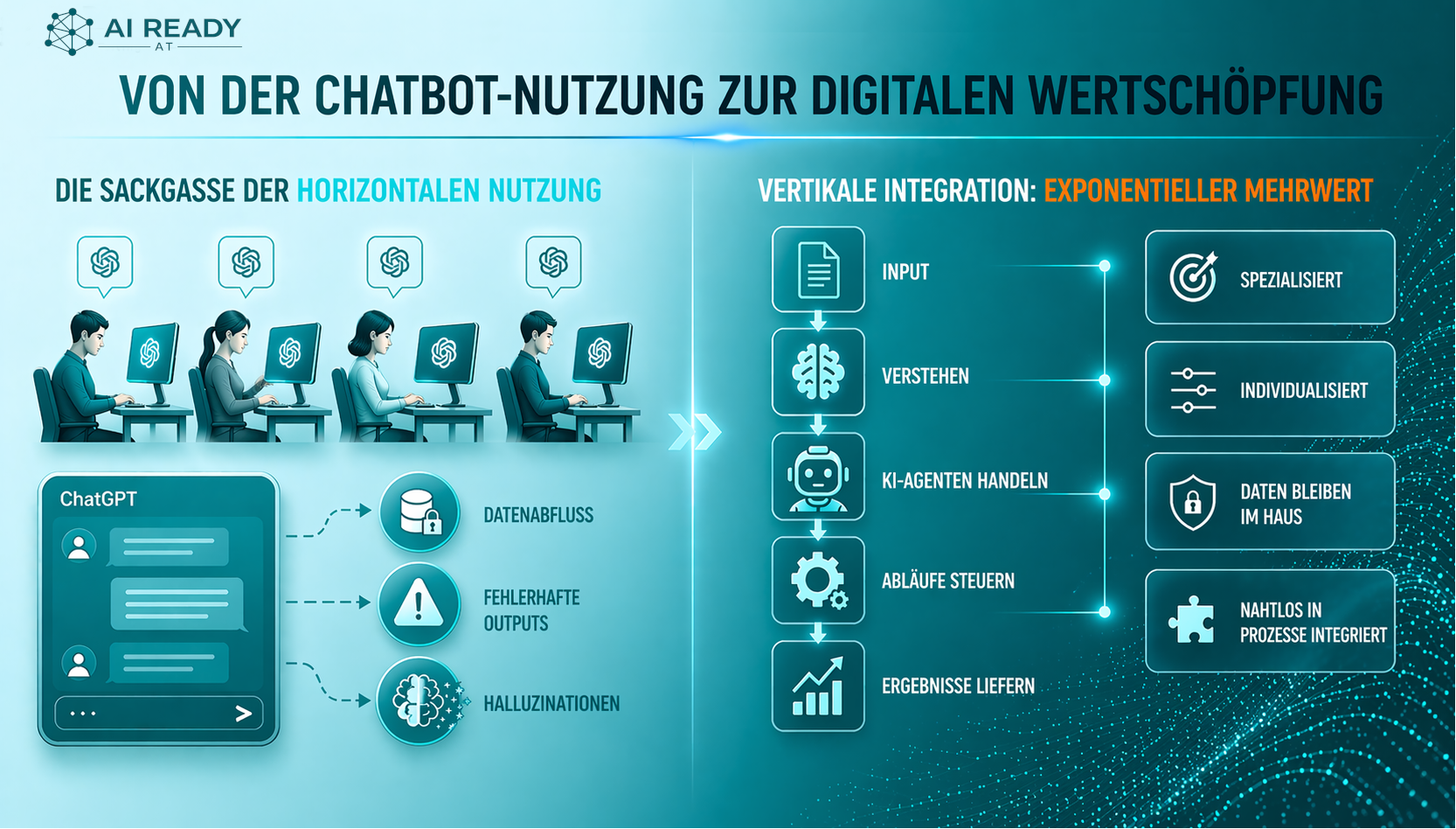
Today, many companies are stuck exactly there. ChatGPT licences are rolled out across the board (horizontally), but usage stays confined to the chat window. A few faster emails don't make a company more efficient as long as the AI has no connection to internal data. On top of that, sensitive information often flows uncontrolled to the outside. My impression from the past months is unambiguous — prompting on the basis of general knowledge is no longer a competitive advantage, it's a baseline. Anyone who wants to stay ahead has to take the next step: vertical integration.
From Chatbot to Digital Employee
The fundamental difference is no longer about giving better answers — it's about acting independently. In place of the assistive chatbot come specialised agents that take on tasks, make decisions along defined rules and work through multi-step processes around the clock — from reading an incoming request to researching the internal knowledge base to delivering the finished result. While a chatbot waits for the next prompt, an agent plans its own steps, calls the necessary systems and reports back only when the result is ready or a human decision is required.
The decisive lever is seamless access to the entire internal knowledge base — precisely controlled through the existing permission structures. This gives agents access to data that previously sat in silos, and lets them actively apply it to the task at hand. Because they operate on real business data, they deliver a reliability that conventional chatbots simply cannot match. Sensitive information stays protected in-house, and every step an agent takes is traceable and logged — a point that is often underestimated in the governance conversation.
Why the World Won't Change Overnight
That doesn't mean everything will be different tomorrow. Even when AI reaches the next major development stage, the economy will not restructure overnight. In my experience, technology is rarely the problem — almost always it is the organisational implementation. New technologies establish themselves in waves: first the pioneers move ahead and secure advantages, then the broad majority follows with a delay, slowed by established systems and uncertainty, and at the end stand the laggards who eventually simply lose relevance.
The real insight from this is almost more important than any technology question: the competitiveness of a company is not measured by how quickly new tools emerge — but by how consistently they are put into practice. Exactly this dynamic is now playing out with agents, and the question is not whether a company will adopt them, but when.
What is usually missing in practice is a clear plan: which application areas genuinely make operational sense, and how do you bring them cleanly into the business? This is where pace is being decided right now, because the technology doesn't wait for the latecomer. And this is precisely where it is being decided who will still be in front.