Production planning & capacity management
Continuously analyses production, order and utilisation data and automatically optimises production sequences, capacity and resource use.
Bottlenecks or delays can be detected at an early stage.
Machinery, quality, predictive maintenance, production planning and reporting — predictive, transparent and with clear early-warning signals.
Use case 01
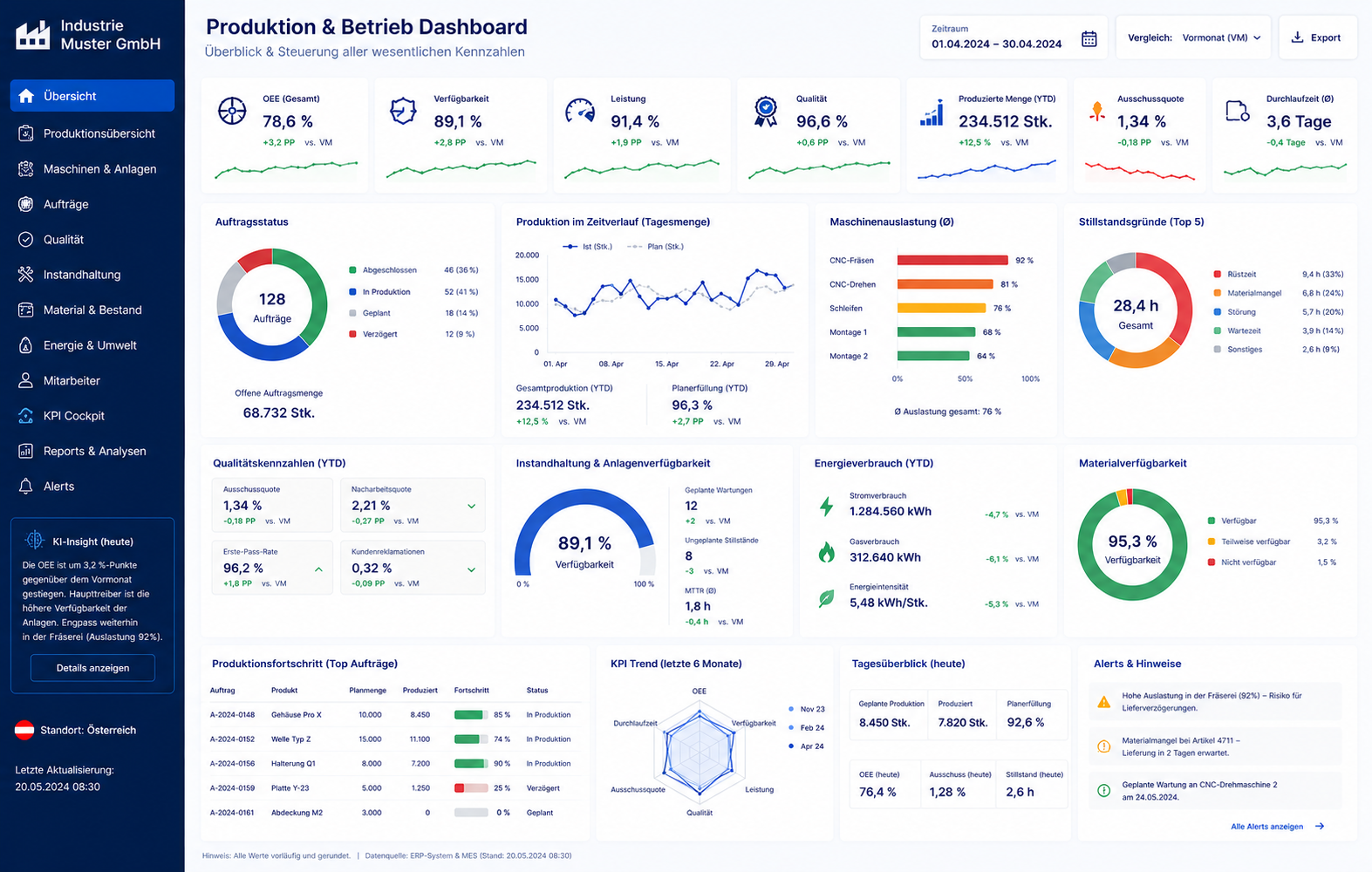
Equipment status, OEE KPIs, maintenance needs and energy consumption at a glance — always current, always available.
The AI dashboard condenses all relevant production data into a visual overview: utilisation, machine status, maintenance dates, material flow and energy consumption are visible at a glance. Early-warning indicators surface bottlenecks, anomalies or impending failures immediately — before they become a problem.
Instead of navigating scattered SCADA and MES data, you see the state of your production in real time — and can direct your attention exactly where it is needed.
How it works
We connect MES, ERP, SCADA, sensors and maintenance systems — securely, locally and GDPR-compliant.
Equipment KPIs, production indicators and maintenance views are configured to your plant structure.
We support and optimise continuously — the system learns alongside your production processes.
Use case 02
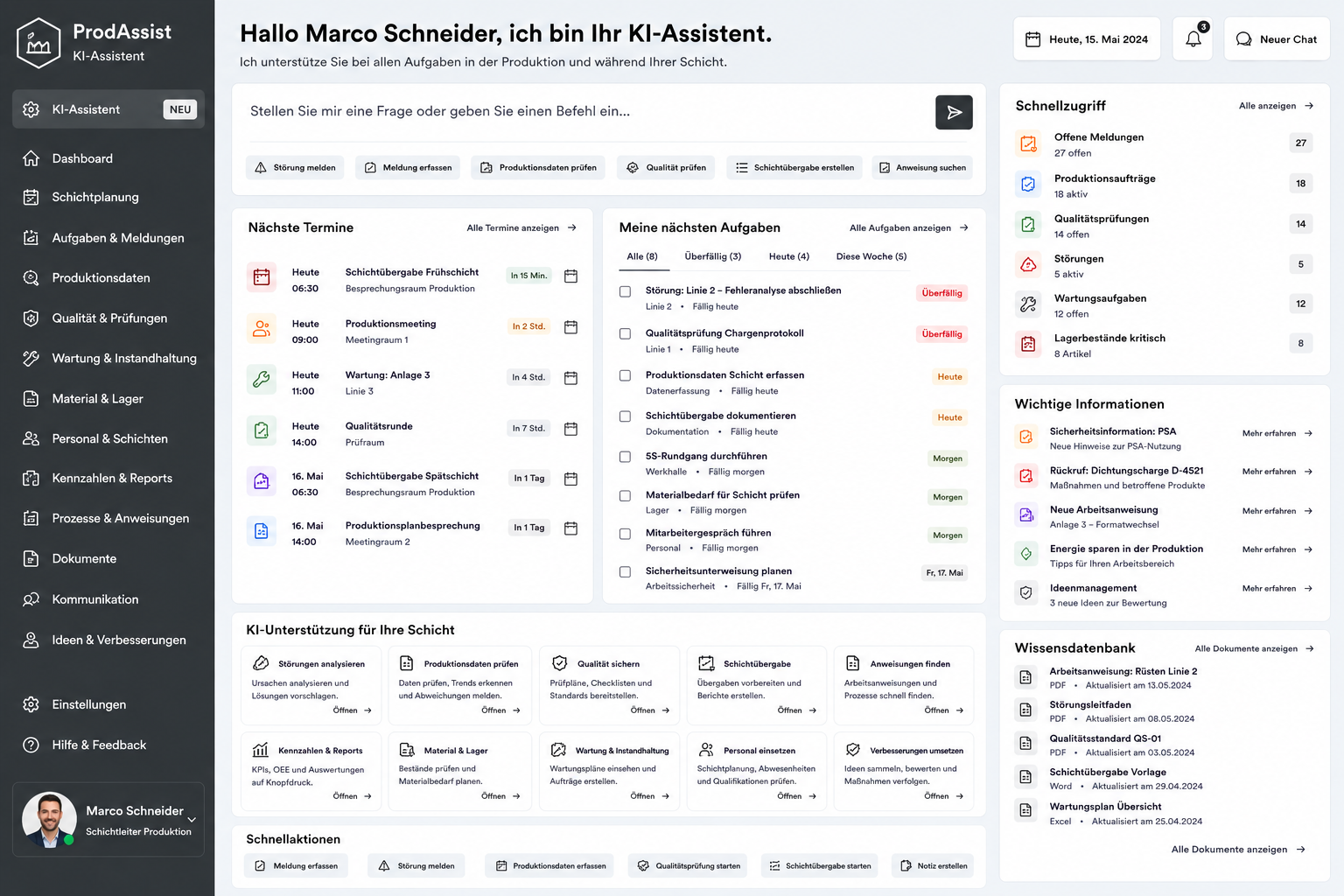
An AI assistant that learns with your production and removes routine work from everyday plant operations.
The AI assistant relieves your employees exactly where routine and detailed knowledge consume most of the time: machine manuals, maintenance logs and fault diagnoses are accessed directly at the workstation, shift logs are kept automatically and step-by-step instructions appear in context. Instead of leafing through manuals, your team focuses on what production is really about.
The assistant learns with your equipment and processes, knows the peculiarities of individual machines and supports operators in setup, changeover and troubleshooting. This frees up more time for value-adding activities — and less for searching and looking up.
Use case 03
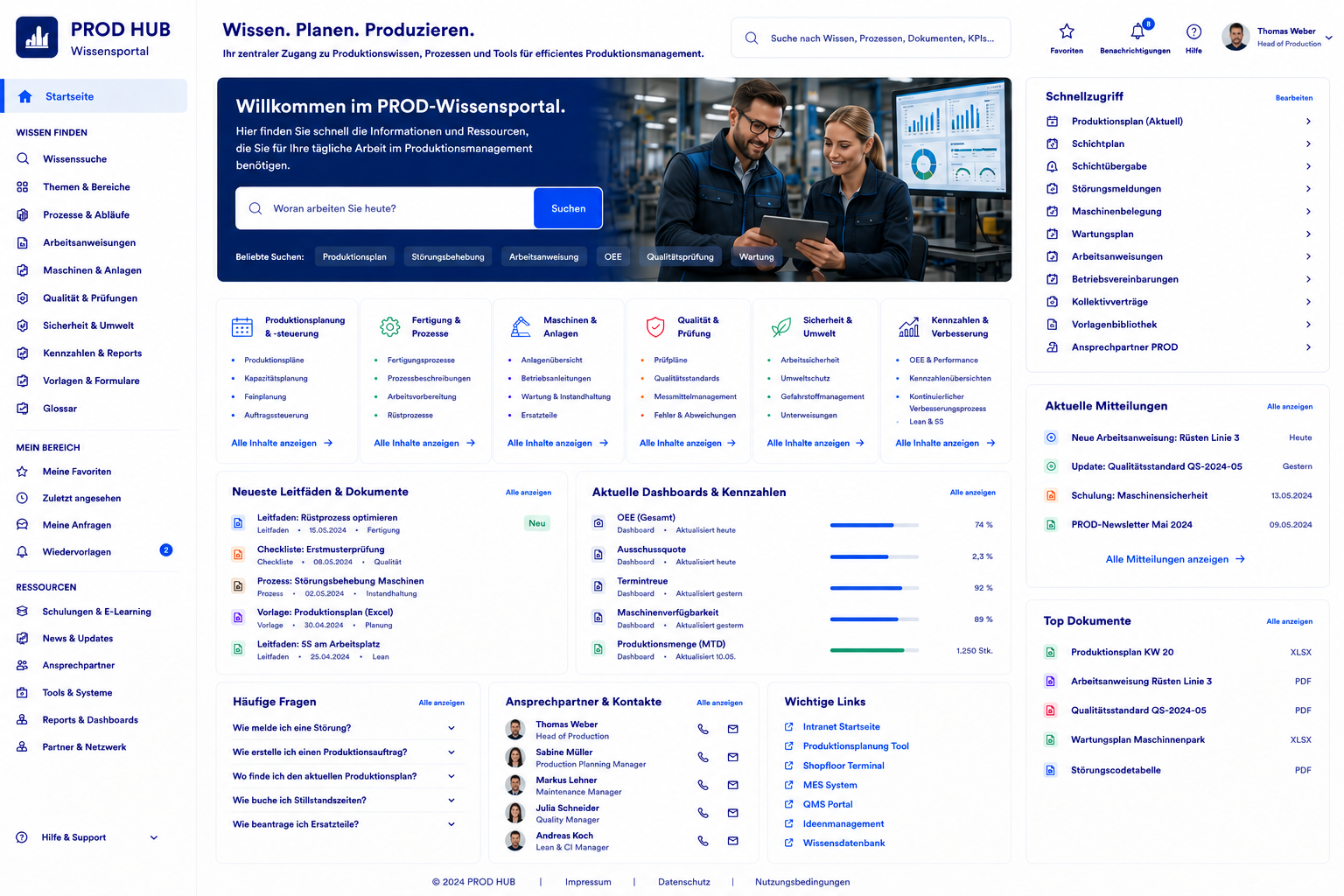
All equipment manuals, procedures and experience from your plant — accessible through a single question.
In addition to AI assistants, the knowledge management platform provides a central, intelligent access point to all machine manuals, procedures, maintenance logs and experience from your production. Complex questions are answered in context — based on your equipment data, technical specifications and past incidents.
Knowledge no longer stays trapped in individual heads or scattered PDFs but becomes a shared tool for the entire workforce. New employees are productive faster, senior know-how is preserved across shift changes — and research times drop to minutes.
Use case 04
Ten areas where your AI agent delivers immediate value for industry and production.
Continuously analyses production, order and utilisation data and automatically optimises production sequences, capacity and resource use.
Bottlenecks or delays can be detected at an early stage.
Analyses sensor data in real time and identifies potential failures, faults or unusual equipment conditions early.
Maintenance and interventions can be planned more predictively.
Automatically prioritises faults, creates maintenance suggestions and coordinates service operations based on machine status, spare parts and availability.
This reduces response times and downtime.
Supports employees directly during production through step-by-step instructions, automated hints, fault warnings and context-aware information.
Processes can be carried out more safely and efficiently.
Detects critical production deviations automatically, analyses potential causes and triggers defined escalation or communication processes.
Production issues can be addressed faster.
Continuously analyses material movements and automatically manages internal transport, replenishment and provisioning.
Material bottlenecks or unnecessary wait times can be reduced.
Coordinates production orders automatically, prioritises work steps and manages approvals or follow-on processes based on current production conditions.
Workflows can be organised more flexibly and efficiently.
Continuously analyses energy and consumption data and identifies optimisation potential as well as unusual load or cost trends at an early stage.
Resources can be used more efficiently.
Automatically monitors production and operations for compliance with safety requirements and regulations.
Risks or potential violations can be detected at an early stage.
Coordinates technical building topics such as fault reports, maintenance requests, operating services and infrastructure processes automatically.
Recurring facility processes can be managed more efficiently.