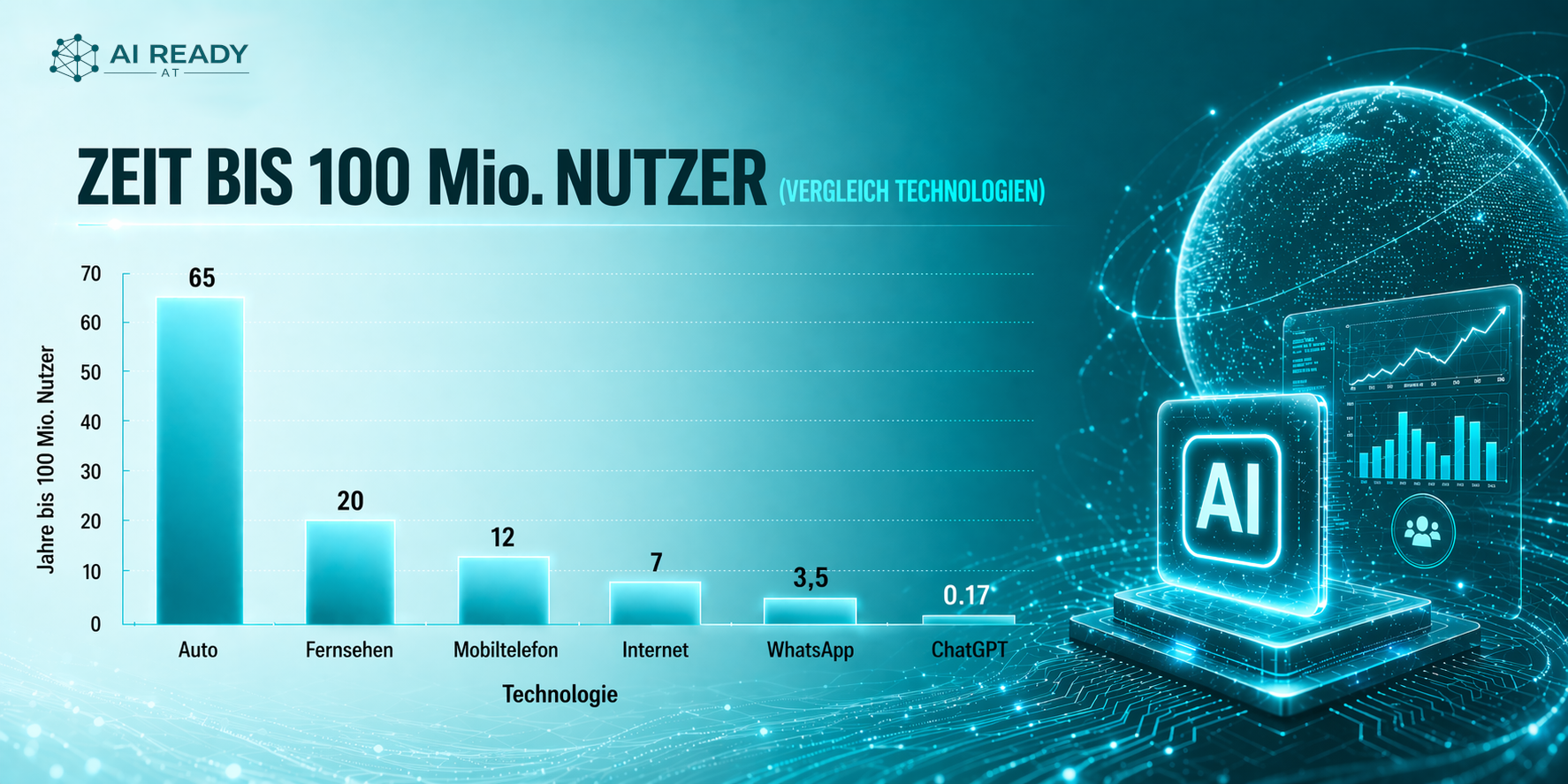
Few technologies have ever pushed into everyday life as quickly as artificial intelligence. The car took around 65 years to reach 100 million users, the internet managed it in seven. ChatGPT did it in roughly two months. Today, weekly active AI users stand at around 900 million — and the pace isn't slowing. Anyone still waiting for the hype to settle is waiting at the wrong end of history.
What I find more interesting than the number itself is what's happening underneath it. AI research has been around for over 80 years, yet it was the launch of ChatGPT in late November 2022 that brought the technology into boardrooms, classrooms and living rooms around the world. Google had something comparable sitting in a drawer for longer, but held back — too error-prone, they said at the time. OpenAI didn't extend the same caution. The answers were often not correct, but compellingly phrased. That precise mix of confidence and imprecision cracked the market wide open. And along the way, the industry picked up a new vocabulary word: hallucination.
Four Phases, One Clear Direction
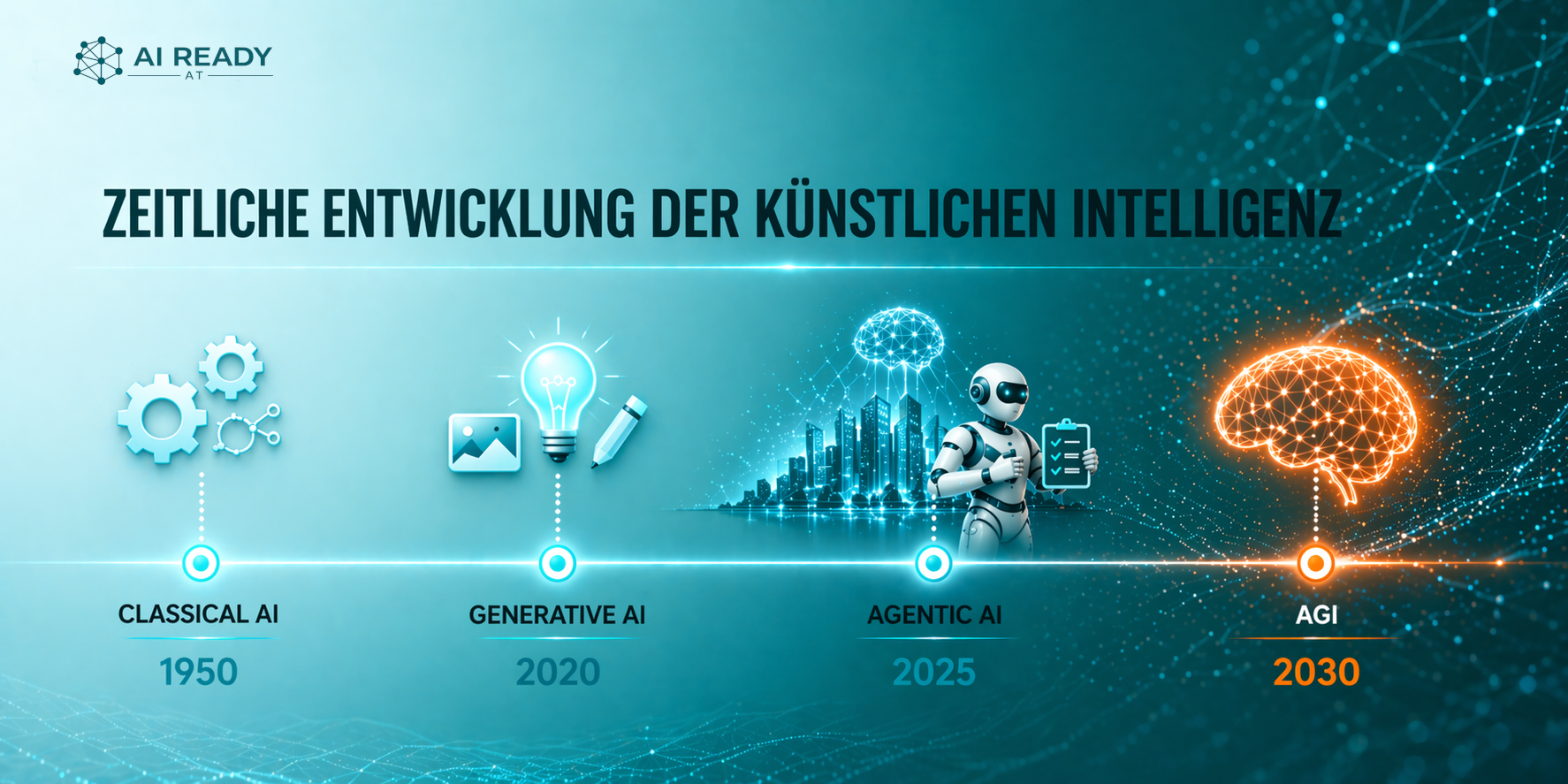
The development breaks down into roughly four phases, as the timeline also shows. "Classical AI" from the 1950s onwards worked with logic and rules, but stayed in the background for lack of computing power. With "Generative AI" from 2022, the technology became visible to everyone for the first time — systems that produce text, images or code on demand, but remain purely reactive. Since this year, the focus has been shifting towards "Agentic AI": systems that pursue goals, make decisions and work through multi-step tasks independently. Less tool, more digital colleague. And somewhere on the horizon, frequently dated to 2030, waits "Artificial General Intelligence (AGI)" — an AI that could solve any intellectual task at least at human level. Still theory, but one companies should be preparing for today.
Electricity from the Socket
What has become particularly clear over the past few months: the raw models are becoming a commodity. OpenAI was long unchallenged at the front, but Anthropic with Claude, Google with Gemini, MetaAI, DeepSeek from China and Mistral from Europe are now delivering performance that is increasingly converging. Measured against standard benchmarks, the models are already operating at the level of human experts — and will soon surpass it.
Andrew Ng (Stanford, former Google Brain) has a fitting image for this: AI models are becoming a commodity, comparable to electricity from a socket. Nobody asks which power station the kilowatt-hour came from — what matters is what you run on it. The same is true of large language models: the competitive advantage is shifting away from the model itself and towards the architecture and applications built on top of it.
The Real Management Question
And that is precisely where the task lies for leadership. The question is no longer which model is the best — the differences are shrinking, the options becoming more interchangeable. What will be decisive is how a company embeds the available AI capability into its own processes, products and teams. Anyone who sets this up cleanly now builds a lead that can no longer be closed by fast IT fixes later. What I see again and again: who is still in front in five years is not decided at some point in the future — it is being decided right now.