As the person responsible, you ask yourself every month:
Why did the gross payroll increase and which bonuses were paid out?
Finding the answer costs your company around 15 hours of working time every month.
What does it take today to get an answer?
Typically, every month — after the preliminary payroll run — a so-called payroll variance report is prepared.
Its purpose is to make the changes versus the previous month visible to management before the payment is approved.
How much effort does this take today?
The effort depends on the number of employees, the payroll model and data quality. For a typical mid-sized company, 6 to 15 hours per month are often needed for analysis, reconciliation and documentation.
For companies with many allowances, shift models or seasonal fluctuations, this can grow to 15 to 30 hours per month.
Why is it so time-consuming?
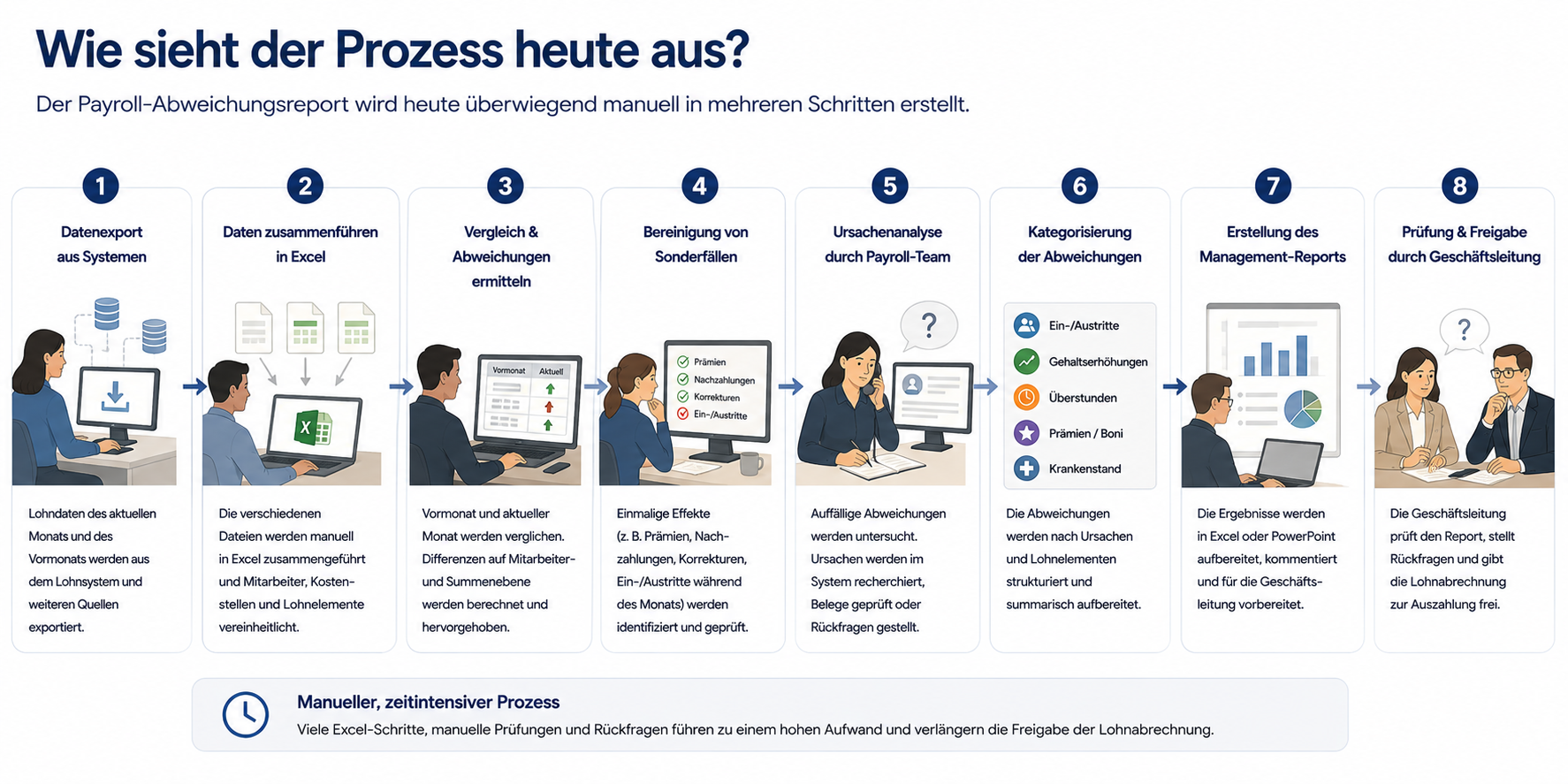
Today the payroll variance report is mostly prepared manually, in several steps: export data, compare months, identify variances, assess anomalies, research causes, categorise, create the report and prepare it for approval.
What result do you get today?
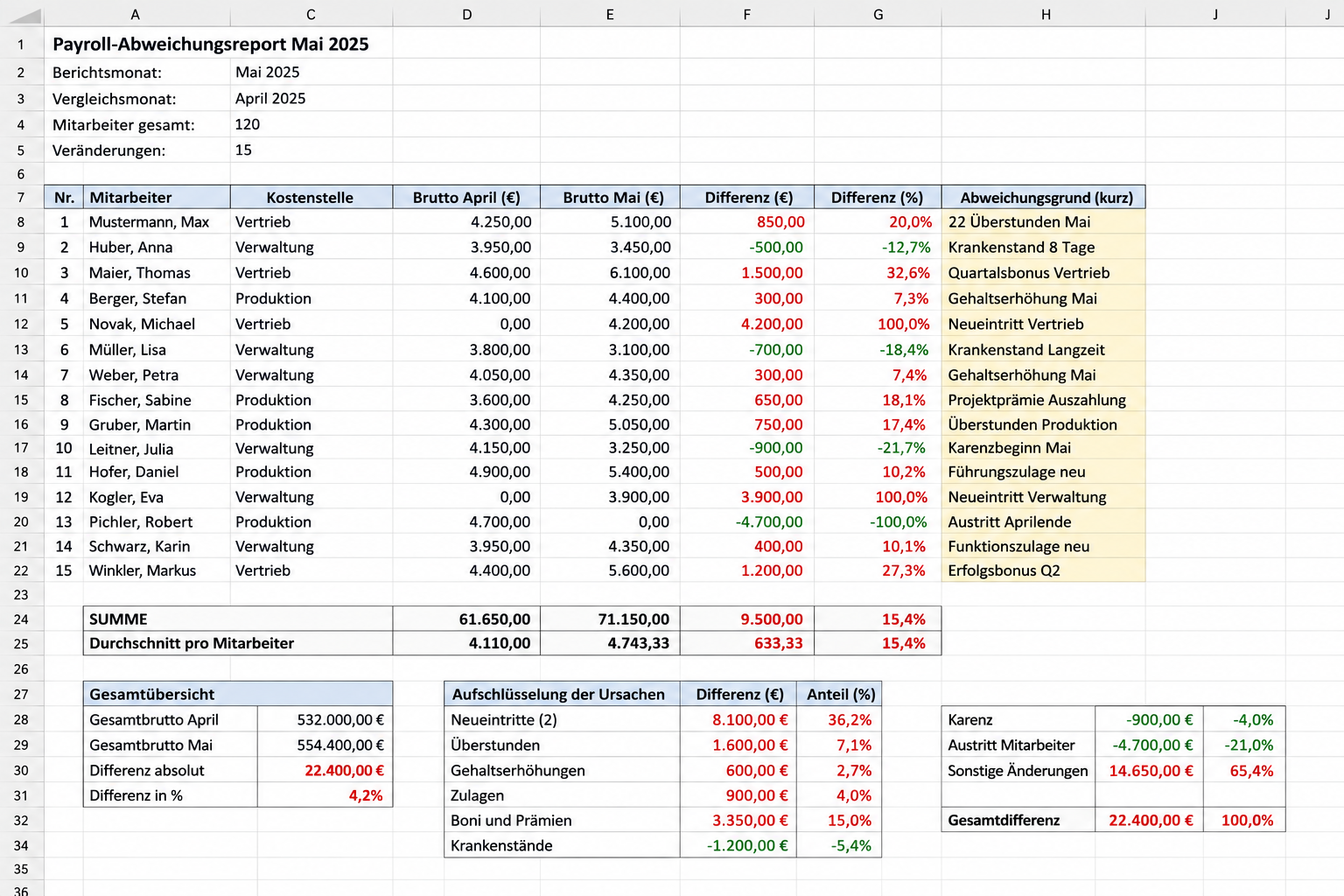
Today the result is typically a large Excel spreadsheet: gross figures per employee, differences to the previous month in euros and percent, plus manually added explanations.
Functional — but time-consuming to produce and hard to grasp at a glance.
How does an AI agent solve this?
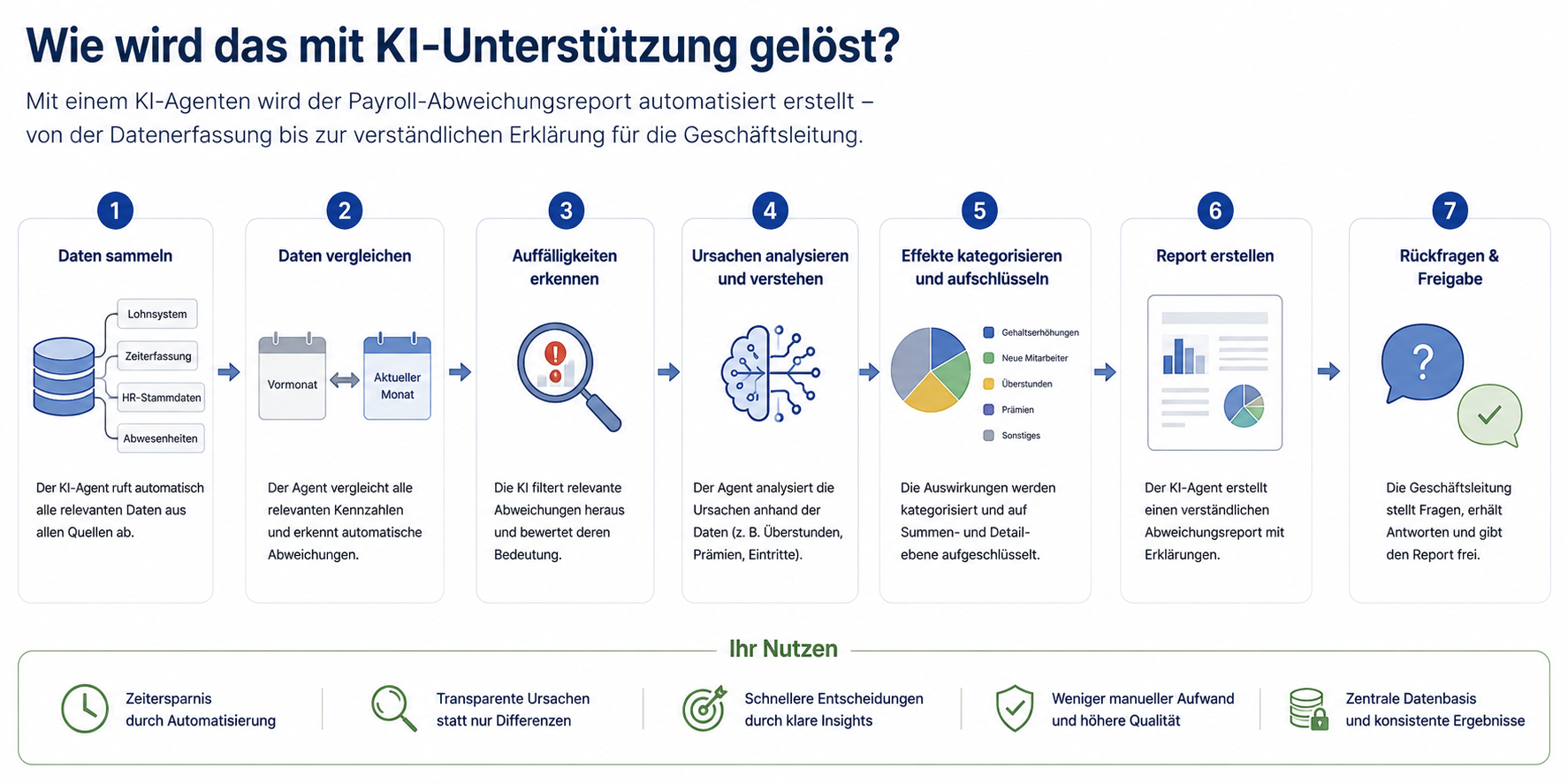
With an AI agent, the payroll variance report is created automatically — from data capture all the way to a clear explanation for management.
The steps: connect data, compare months, detect anomalies, analyse and understand causes, categorise and break down effects, create the report, query & approval.
What savings does it deliver?
Take a typical mid-sized company that today — conservatively estimated — needs about 10 hours per month for the payroll variance report. At an internal fully-loaded hourly rate of €60, this amounts to roughly €7,200 in costs per year.
After introducing an AI agent, often only 1 to 2 hours of review and plausibility checking per month remain.
€5,500 – 6,500direct savings per year
On top of that, the quality of the analyses increases, errors are spotted earlier and management receives reliable decision-making input faster.
And what does an AI-agent report look like in practice?
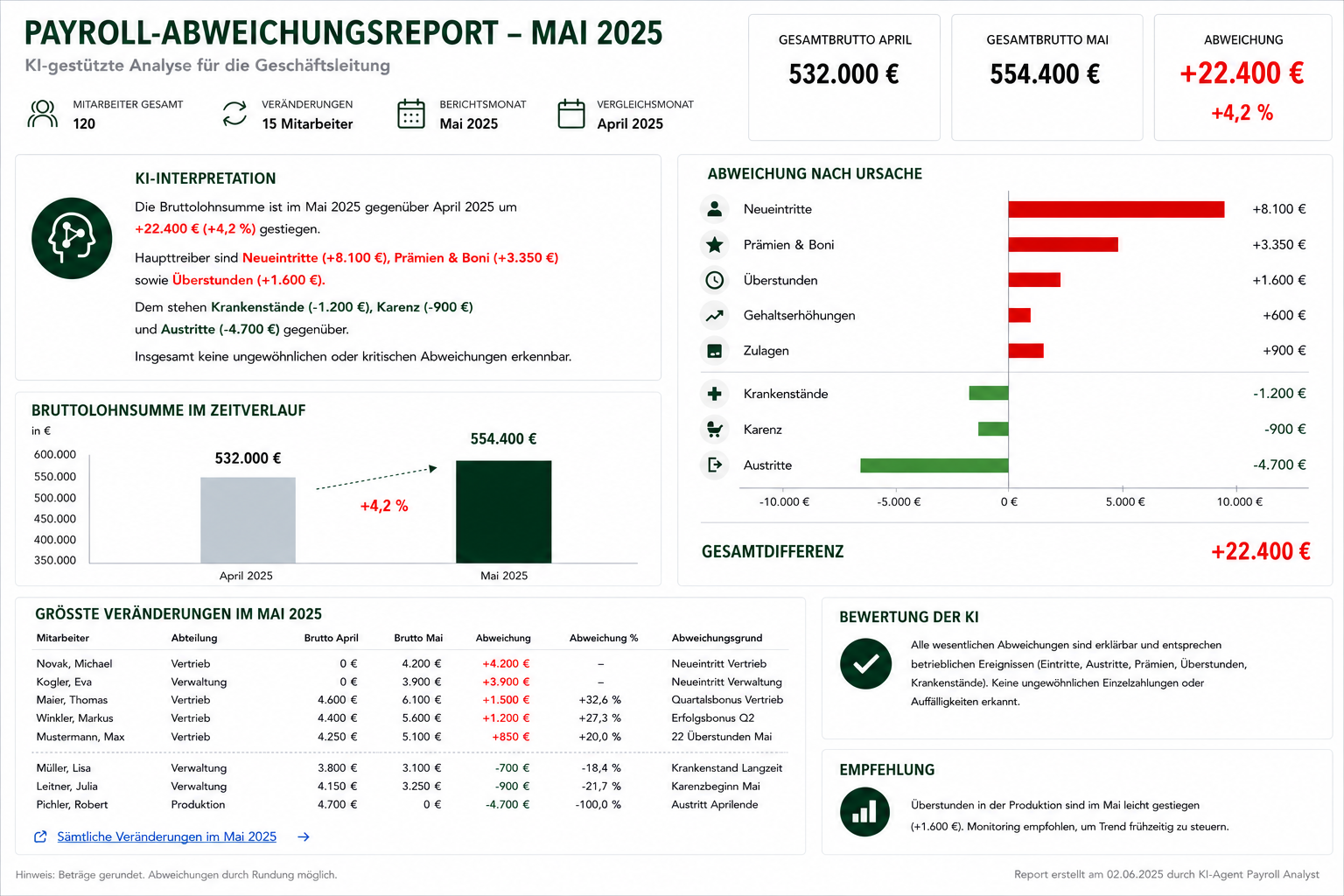
Instead of an Excel spreadsheet, management receives a clearly structured report: overall change at a glance, variances by cause, an AI interpretation of the anomalies and an assessment with a recommendation for approval.
Implementing an agent pays for itself within approximately one year and delivers a lasting saving of 80–90 %.
And what about data protection?
The solution runs entirely within your own infrastructure: your data never leaves the organisation and is not transmitted to external services or AI providers. Access is restricted to people you have authorised.